
Pop the bonnet in Singapore and there is a fair chance you will spot it: a crusty white, blue or green growth sitting on one of the battery terminals. It looks minor, a bit like limescale on a kettle. But we see corroded terminals on a lot of the cars we attend to, and in plenty of no-start calls the battery itself was perfectly fine. The corrosion was simply blocking the power from getting out. This guide explains what the stuff is, why it grows so quickly in our climate, how to clean it safely, and when it is a sign you should replace the battery instead of scrubbing it.
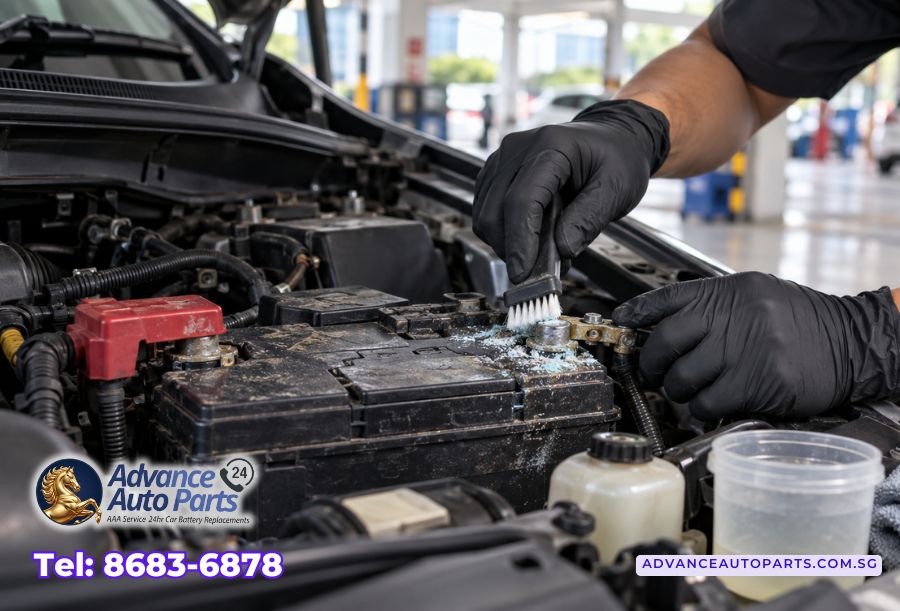
What Is That White or Blue Powder on Your Car Battery?
The powder is dried residue from battery acid vapour reacting with the metal around it. A lead-acid battery, which is what almost every petrol and diesel car in Singapore uses, gives off tiny amounts of hydrogen gas and acid mist while charging and discharging. That vapour settles on the terminal posts and the metal clamps, and the chemical reaction leaves a crystalline crust behind.
The colour tells you a little. White or pale grey powder is usually lead sulphate on the positive or negative post. Blue or green crust is copper sulphate, which shows up when the clamp or the cable end is copper or brass and reacts with the acid. Some people call it battery cancer, which is dramatic, but it does describe how it behaves: it spreads if you leave it alone.
The important point is that corrosion is a poor conductor. Your starter motor pulls a huge burst of current, often 200 amps or more on a cold engine, and every bit of crust in the path acts like a partly closed tap. The battery may be full, yet the car cranks slowly, clicks, or does nothing at all.
Why Corrosion Grows Faster in Singapore
In our workshop experience, cars here develop terminal corrosion sooner than the same batteries would in a cooler country. There are three reasons, and none of them are your fault.
First, heat. Under the bonnet of a car parked in the open at a Housing Board carpark, temperatures easily pass 60 degrees Celsius by mid-afternoon. Hot batteries release more vapour, and hot metal reacts faster. Second, humidity. With the air sitting at 80 to 90 percent most days, moisture on the terminals acts as the water that helps the reaction along, and it never fully dries out. Third, the daily thunderstorms and the occasional car wash. Water and acid residue mixing on the posts is exactly what the corrosion wants.
Add short trips into the mix. If most of your driving is ten minutes from home to the MRT, the alternator often does not get enough time to top up the battery properly. A battery that is constantly slightly undercharged tends to vent more, and vents mean more crust.
The Real Causes, Not Just the Weather
Weather speeds things up, but something usually starts it. The most common causes we find are these. An old battery that has begun to leak around the post seals, so acid creeps up the terminal from below. An overfilled conventional battery, where someone topped up the cells with too much distilled water and the liquid bubbles out. An alternator that overcharges, which cooks the battery and makes it gas heavily. Loose clamps that allow tiny sparks and heat at the joint. And plain old age, since almost every battery corrodes eventually as the seals wear.
If you clean the terminals and the powder is back within a couple of weeks, do not just keep scrubbing. That pattern points to a leaking post seal or a charging fault, and it is worth having the system tested. A proper check of the alternator output, usually between 13.8 and 14.5 volts with the engine running, will tell you if the car is overcharging the battery.
Is Terminal Corrosion Dangerous?
For the car, it can leave you stranded. For you, the crust is mildly acidic and can burn skin or eyes and stain clothes, so it should not be touched with bare hands or wiped with your good towel. The gas released by any battery is flammable, so never smoke, and keep sparks and naked flames away when working near it.
Corrosion can also do slow damage to the cables. If the green copper sulphate creeps inside the cable insulation and runs along the wire, the cable itself will need replacing, not just cleaning. That is a job for a workshop, and it costs more than the cleaning ever would have.
How to Clean Battery Terminals Safely
You can do this yourself in about 20 minutes if the corrosion is light. Here is how we would do it, in order.
Switch off the engine and take the key out. Put on safety glasses and rubber gloves, and roll up your sleeves. Old clothes are wise. Find the negative terminal, marked with a minus sign and usually with a black cover, and loosen its clamp first with a spanner, generally 10mm. Lift the clamp off and tuck it to the side so it cannot swing back onto the post. Then repeat for the positive terminal, which has the plus sign and a red cover. The order matters: negative off first, negative on last. This avoids accidentally sparking a spanner across the body of the car and the positive post at the same time.
Mix about two tablespoons of baking soda in a cup of warm water. It fizzes when it meets the acid crust, which is exactly the point, since the baking soda neutralises the acid. Dip an old toothbrush into the mixture and scrub the posts and the insides of the clamps. Keep the liquid off the paintwork and out of the battery vents. Wipe everything off with a damp cloth, then dry it with a clean, dry one. A proper battery terminal brush, sold at most accessory shops for a few dollars, cleans the inside of the clamps far better than a toothbrush.
Once the metal is shiny and dry, put a thin layer of petroleum jelly or a dedicated terminal protector spray on the posts and clamps, then reconnect. Positive on first this time, then negative. Tighten firmly, but do not go crazy with the spanner, because overtightening can crack the lead post or warp the clamp. Give the clamp a wiggle by hand. If it moves, tighten it a little more.
Afterwards, start the car and check that everything works. The clock and radio presets may have reset, which is normal. On newer cars with start-stop systems, a hybrid, or a battery management system, disconnecting the battery can cause some warning lights or an idle relearn. If you drive one of those, and if you are not comfortable, have a technician do it, since some cars need the new battery or the reconnection to be registered with the computer.
What About Cola, Hot Water and Other Kitchen Tricks?
You will see people online recommending cola or pouring a kettle of hot water over the terminals. Cola does dissolve some corrosion because it is acidic, but it leaves a sticky sugar residue that attracts more moisture and dirt, which is the last thing you need in Singapore humidity. Hot water can push the acid crust into places you do not want it, like the electrical connectors nearby. Baking soda is cheap, easy to find at any supermarket, and does the job properly.
How to Stop Corrosion Coming Back
Prevention is mostly boring habits. Keep the top of the battery clean and dry. Make sure the hold-down clamp is tight so the battery does not shake around, since vibration loosens the seals over time. Check the terminals whenever you check your oil, maybe once a month, and wipe away any early powder before it builds up. Coat the clean terminals with a bit of grease or protector.
Some workshops also fit felt anti-corrosion washers, the little red and green rings that go around the posts. They are cheap and they help, although they are not magic. And do not let a battery sit for weeks unused. If you are going away for a long holiday, our advice on stopping a battery from going flat while you travel applies here too, because a battery that sits flat and warm tends to corrode more.
Also think about your driving pattern. If your car mostly does short hops, a longer drive on the expressway once a week lets the alternator properly recharge the battery and reduces gassing. It is one of the easiest things you can do for both the battery and the terminals.
When Cleaning Is Not Enough: Time to Replace the Battery?
Sometimes the corrosion is a symptom, not the problem. A few signs that cleaning will not save you. The battery case is swollen or cracked. You can see wetness or acid weeping around the base of the posts. The battery is more than three to four years old and the car has become slow to crank. Corrosion returns within days of cleaning. Or the terminal posts themselves are eaten away and no longer fit the clamps tightly.
Cars in Singapore typically get about two to four years out of a conventional battery because of the heat, and a bit longer from a good AGM or EFB unit. If you are past that window and the terminals are crusty, a replacement is often the smarter spend than chasing the problem. A load test will show you the true condition in a few minutes. Ask for one before you decide.
If you do decide to replace, brands matter. Akiro is a solid choice we fit regularly, and it is built for tropical operating conditions, with well-sealed posts that resist the creeping acid that starts corrosion. Other good names include Bosch, Amaron and Hoppecke, and the right pick depends on your car, especially if it has start-stop, in which case you need an EFB or AGM battery rather than a standard one.
How Much Does It Cost to Fix Corroded Terminals in Singapore?
Cleaning the terminals yourself costs a few dollars for baking soda, a terminal brush and a little grease. If you would rather have a workshop do it, expect roughly SGD 20 to SGD 50 for a terminal clean and protection, sometimes free if you are already getting a battery test done. Replacing a corroded battery clamp is typically SGD 15 to SGD 40 for the part, plus labour. A damaged battery cable is dearer, often SGD 80 to SGD 200 depending on the car. A new battery ranges from about SGD 120 for a basic unit to SGD 400 or more for an AGM on a European car, with fitting. These are ballpark figures, and prices move, so check before you commit.
If you are stuck at home or in a carpark and the car will not start because of corrosion, our mobile team can come to you. We clean the terminals on site, test the battery and alternator, and tell you plainly whether it is worth keeping the battery. No pressure to buy something you do not need.
Quick Answers to Common Questions
Can corroded terminals stop a car from starting? Yes. Heavy corrosion can block enough current that the starter only clicks, even with a healthy battery. Can I jump-start a car with corroded terminals? You can try, but clean at least the clamp contact points first, otherwise the jump leads will not make a good connection either. Is it safe to drive with white powder on the battery? A light dusting is not urgent, but clean it soon before it builds up. How often should I check? Once a month is plenty, and always before a long drive or a holiday.
A small habit of looking at your battery terminals every few weeks saves a lot of grief. Spot it early, clean it properly, and work out why it happened. If the powder keeps coming back, or the battery is already in its third or fourth year, get it tested before you end up calling for help at 11pm in a wet carpark.